Guide to Hire Talented Engineers at a Startup
Table of Contents
Overview
A practical guide on what has worked best to hire talented people on my personal the engineering department.
Key Ideas
- Use an Application Tracking System (ATS) if the budget allows for it. You will save tons of time and improve the quality of the hiring process.
- Define and communicate the hiring process to the team before posting jobs. Alignment is important.
- Define a Hiring Manager to oversee the process and onboarding.
The Hiring Manager must be responsible to overview the process and ensure candidates are treated fairly as well as high standards are maintained. Decide the hiring steps, and who will be responsible to conduct them (first call, peer coding, due diligence, etc).
The hiring process needs to adapt to the department and position. I prefer to define the job first, and later create the hiring process or alter the existing one if needed.
Define the Job
Everybody has seen unrealistic job posts with super long lists of requirements or crazy expectations, like asking for more years of experience than the tech has been around. Let's avoid it, and start by creating a scorecard to be the foundation of our job description. The scorecard will list several skills, and the idea is to grade them (from 1 to 5) during the hiring process. They will be used to reject candidates early on and to be more objective in the final decision. I've defined the following scorecard template:
Scorecard Template
- Mission: Define what contributions you expect the new hire to make.
- Outcomes: List 2-3 measurable OKRs to assess success (3 to 6 months after onboarding).
- Soft Skills (4-6): Identify key traits that align with company values (e.g., punctuality, communication skills, teamwork, structured thinking).
- Hard Skills (4-8): What expertise do you need to complete the mission? Define specific technologies, compliance standards, etc.
Job Description Structure
From the scorecard, you can easily derive the job description. You will keep the outcome private, and use the missions and the skills to list the knowledge and qualifications requirements. Do not publish all the skills requirements, publish the most critical, objective, and measurable skills, and keep the other private to grade during the process. In my opinion, the job description should have:
- Company Overview (Max 80 words)
- Job Mission (Max 50 words)
- Work Requirements (Remote, hybrid, acceptable time zones, etc.)
- Must-Have Skills (Essential qualifications and experience)
- Nice-to-Have Skills (Max 2 additional skills)
- Key exciting topics (Tech stack, culture, career growth, etc., to give a full picture of the company)
- Compensation (Stock options, phantom plans, and optionally, salary bands). Depending on the role, budget, and the company context, you might not want to publish the salaries in the job offer.
Structuring the Hiring Process
The hiring process needs to be explained in the first contact with candidates, and questions will arise during the interviews. Therefore, everyone will need to be aligned on the process.
Keep the scorecard handy and grade the candidate's skills during or after each interview. It's also helpful to leave space next to each grade to note specific answers to questions or any observations. In a startup environment, it's beneficial to share all insights and observations with everyone involved in the process as early as possible. This allows the team to dig deeper if there are any concerns. This goes against experts' recommendation of not sharing the individual assessment until the end of the process to not influence others, which might work for non-tech roles or large companies, but not for startups.
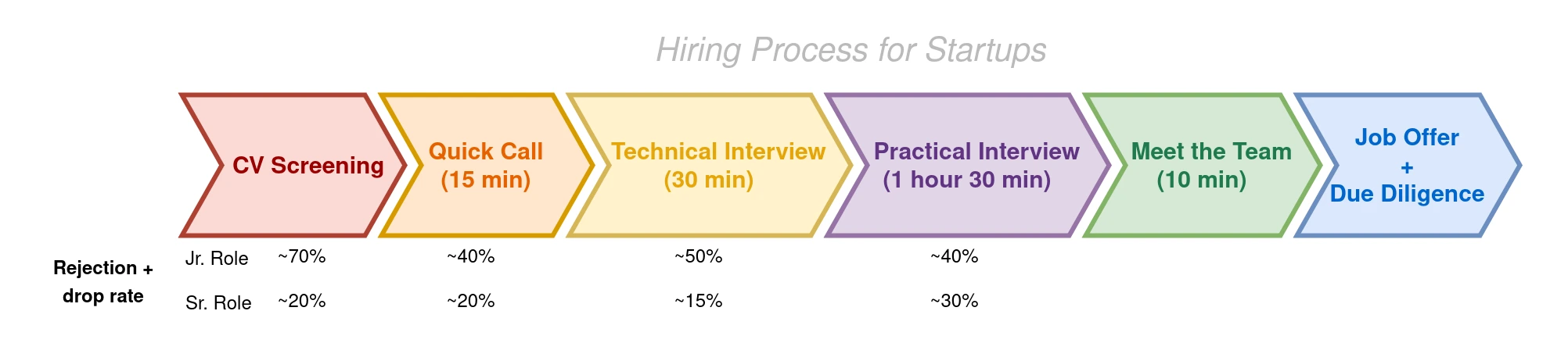
Define both hiring and rejection flows. Specify process steps, assign interviewers, and prepare exercises as needed. The hiring manager should ensure that all skills listed in the scorecard are assessed and set clear rejection criteria. Be mindful of red flags and don't justify them (e.g., inconsistent expertise claims, inappropriate comments). For tech roles, I've defined my own hiring process.
Hiring Process
- CV Screening: Review applications and filter out those that don't meet basic criteria (timezone, minimum qualifications,.. ).
- Quick Call (15 min): A short check, conducted by any qualified team member, to confirm basic qualifications, location, and expectations. Explain the hiring process. Many applicants don't fully read job descriptions, so this helps filter out mismatches early. In my experience, the rejection rate for junior roles is about 60%, while for senior roles it is around 10%.
- Technical Interview (30 min, conducted by a tech team member): Discuss the working experience and exciting projects. Find some common ground relevant to the job to dig down on technical reasoning and expertise.
- Practical Interview (1 hour 30 min, conducted by a tech team member & hiring manager): Live coding exercise with screen sharing or peer programming. The discussion matters more than completing the task or being familiar with specific dev tools and frameworks.
- Meet the Team (10 min): I try to make it right after a successful practical interview; however, sometimes it cannot be arranged with the team and needs to be scheduled on a different date. The goal is twofold: first, to receive feedback from potential teammates, and second, to allow candidates to see the work environment.
- Job Offer (Pending Due Diligence): Extend an offer while making it clear that references will be checked. Obtain permission before contacting current employers, and ask the contact details.
Internal Metrics
The idea is to monitor the quality and detect areas of improvement in the hiring process. I'd suggest to monitor these metrics:
- End-to-End Time (E2E): Time elapsed from application to final decision.
- Time to First Reply: How quickly candidates receive their first response.
- Net Promoter Score (NPS): Ask the candidate to grade the hiring process at the end of the process. If you want to hire talented people, you must treat potential hires fairly and with respect.
Onboarding
The goal of onboarding is to enable employees to contribute to the company as quickly as possible while ensuring their autonomy. A useful strategy is to assign a working buddy who will assist the new employee by answering questions and providing information regarding their tasks.
At the beginning of the onboarding process, it is important to clarify the following key points:
- Company Mission and Values
- Career Path and Performance Reviews
- Day-to-Day Processes: Clarify essential daily processes, including the use of HR platforms, attendance at daily meetings, and organization (sprints, OKRs,.).
- Working Policy: Specify whether the schedule is a strict 9 to 5 or flexible. Also, explain the company structure and reporting lines.
- Expectations: Define what is expected of the new employee and how to support their success. Provide domain-specific knowledge and introduce them to their buddy.
Last but not least, define recurrent meetings, besides the 1to1 with the manager, to detect any missing support, avoid alienation, and revisit whether the outcomes defined for the job position were accomplished.
References
This guide has been heavily influenced by the book Who: The A Method for Hiring by Geoff Smart and Randy Street. It is a comprehensive guide that provides a structured approach to hiring, including the scorecard methodology and detailed templates that I have adapted to my needs. Visit their website for additional templates and tools.